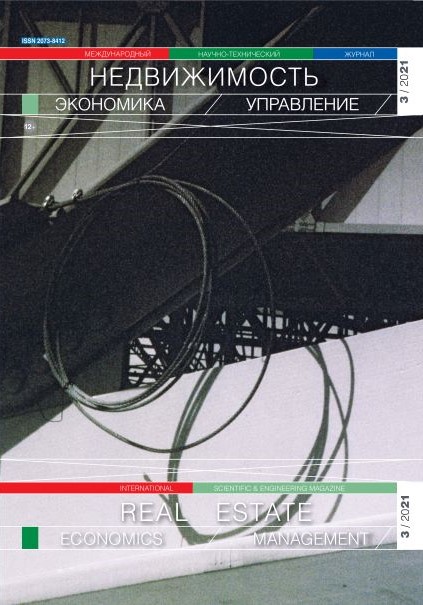
Realty estate: economy, management
No. 3 (2021)
Dear readers,
One of the priority areas identified by the President of the Russian Federation V.V. Putin in his address to the Federal Assembly of the Russian Federation is the introduction of a special mechanism to support individual housing construction.
Putin in his address to the Federal Assembly of the Russian Federation is to introduce a special mechanism to support individual housing construction and ensure its widespread application (subparagraph 2 of the list of instructions dated 02.05.2021).
Construction of all kinds, including low-rise mass construction, is an extremely complex process involving many participants, directly or indirectly. Consequently, the obstacles to the construction process are of very different origins.
One of the reasons that hinder the provision of affordable low-rise housing to Russians is the lack of a clear policy by the authorities regarding the technological support of the construction process. Officials are not yet clear which technologies are to be preferred, as a result, some pilot projects are implemented, but there is no mass construction.
It is not difficult to understand that the choice of construction technology depends on what the desired output is. This raises the question: what kind of houses are needed in Russia? Obviously, a low-rise production house should be cheap, quick to build (i.e. consisting of lightweight structures), certainly warm and, finally, aesthetically appealing, and taking into account the taste preferences of potential consumers. In addition, the houses need to be durable and, if demolished, recyclable without damaging the environment. Therefore, appropriate technologies should be chosen for mass high-rise construction in Russia. But the advantages of a particular technology are easiest to evaluate in an open competition among manufacturers. In Europe, such competitions are held in the form of cottage developments. Usually, events follow the following pattern: the city administration allocates a vacant area outside of the existing housing estate. Then, on that land, various companies use their own technology to build low-rise housing, and the end consumer votes with his or her wallet. Similar schemes are regularly held in Germany, Austria and Finland.
In fact, state support of individual housing construction is implemented as a tool to solve the problems of privileged and certain groups of the population, who use inefficient and expensive technologies in construction. The state-funded individual housing construction projects that are put into operation do not always meet modern requirements and the costs incurred. Using foreign experience, in order to develop individual low-rise housing construction, state support should be provided for the introduction of modern construction technologies that meet the parameters of financial affordability of construction, comfort, durability, environmental friendliness, energy efficiency, etc.
The implementation of effective development of low-rise individual construction involves organizing annual sales exhibitions to form offers for individual customers, implementing state programmes of individual low-rise construction for certain categories of people (victims of natural disasters, man-made accidents, civil servants and municipal employees, etc.), and forming a competitive market for developers' offers within the above-mentioned criteria.
The implementation of the proposed project for the development of individual low-rise construction in Russia implies the participation of both federal, regional and local authorities as well as non-state organizations (construction, banking, etc.) in its implementation.
Affordable low-rise housing has a prominent role to play in this process. It is expected that the development of the low-rise suburban housing sector will help to solve a whole range of housing problems in the regions and thereby create the prerequisites for their development.
However, the pace of low-rise construction is still far from what is desirable. Why is this happening? What barriers stand in the way of building mass low-rise housing? These and other problems will be discussed in this issue of the magazine.
Sincerely,
Peter Grabovy,
Editor-in-Chief

Realty esate: economy, management
No. 2 (2021)
Dear readers,
All the many different types of construction management organization forms that are not part of the general contracting or design-build system can be classified as construction management type organizational forms.
One of the most common organizational forms of effective interaction between all participants in the construction investment process is project
management, which is the targeted management of all human, financial, material and energy resources required to ensure effective management processes through the following criteria: time, cost, quality, alignment of changes in the project with stakeholders.
Large project management systems, which take 2-3 years to implement, implement a systematic approach to solving complex problems of regional or even national importance.
The main differences between programmatic and project management systems result from differences in the duration and complexity of projects. The main effect of a programme management system is that it generally provides a lower final project cost (mostly fixed-price contracts).
The reason for this is to create so-called synergy effects in the programme management system and to deepen the specialization of the firms involved in the project or programme. The organizational forms of management and contractual relationships in construction are the focus of the main articles in this issue.
Sincerely,
Peter Grabovy,
Editor-in-Chief

Realty estate: economy, management
No. 1 (2021)
Dear readers,
In Russia, under the new Constitution of the Russian Federation (Article 114, paragraph 1, e. 5), the state authorities are obliged to promote every citizen's right to housing and to encourage them to organize their own living arrangements. Thus, the starting point for solving housing problems is the fair and equitable satisfaction of the basic needs of citizens.
In accordance with the main objectives of improving the living conditions of Russian citizens, every individual residing in Russia is given the opportunity to obtain suitable housing on the basis of three criteria:
1) each family shall have a flat whose number of rooms and area are appropriate to the size of the family and the individual needs of its members;
2) the composition, design and equipment of a flat must be appropriate, in compliance with environmental regulations and functionality, and the dwellings must fit in with their surroundings;
3) the housing costs are reasonable and proportionate to the number of family members and the premises used and the amount of additional costs.
Social grants are primarily intended for those families who are unable to achieve an acceptable standard of living if they do not have the means to do so. This means that the primary responsibility for paying for the organization and costs of housing lies with the citizens themselves.
In addition to social and commercial rented housing, a special form of corporate housing - a flat with the right of residence and gradual redemption - is becoming popular in some regions of Russia as an experiment. This form has existed in many countries for a long time, and in the Nordic countries of Europe and Canada it forms a significant part of the housing stock - 12...17%. What these forms of housing have in common is that a citizen in need of housing can obtain it with little equity by paying a right of residence fee, which is at least 5% of the value of the flat.
It cannot be sold arbitrarily because it is a cross between a private flat and a rented flat.
This form of housing is becoming popular because the security of tenure is reliable from the point of view of citizens' right to housing. This initiative is now being discussed in the State Duma of the Russian Federation. These and other housing problems, as well as mechanisms for solving them, are presented in this issue of the magazine.
Sincerely,
Peter Grabovy,
Editor-in-Chief